

Is the NFZ collapsing? How much do doctors earn? What about hospitals? Dr n. med Zbigniew Król president of the MCM in Milicz. Episode 120
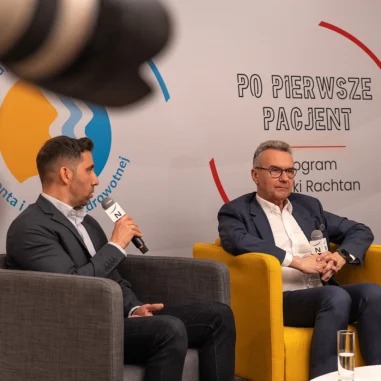
Are Polish hospitals really „failing” and the NFZ is on the brink? In this episode, Monika Rachtan talks to Dr Zbigniew Król - president of Milicz Medical Centre and adjunct professor at UMW - about why 2025 was an exceptionally difficult year for district hospitals. We touch on the subject of overcontracts that have not been funded, the pressure for pay rises, the media's vicious attack on doctors' salaries and the closure of delivery rooms due to staff shortages.
NFZ on the brink? What really happened in 2025 and why county hospitals are scared of 2026
Is Polish healthcare just entering the year when „something will break”? The end of 2025 was full of alarmist headlines: NFZ is collapsing, hospitals have nothing to pay from, doctors are earning crores, delivery rooms are disappearing from the map and patients will be left with nothing. It's just that there is a gap between media panic and the real life of a hospital. We talk about this gap in „Po pierwsze Pacjent” with Dr Zbigniew Król - president of Milicz Medical Centre and assistant professor at the Medical University of Wrocław.
It is a conversation without political slogans, but with the perspective of the person who is responsible every day for ensuring that wards are working, staff have something to work for, and patients get the service when they need it.
2025: „extremely difficult” because nothing could be planned
For many hospitals, especially district hospitals, 2025 was a difficult year for one fundamental reason: predictability was gone. Previously, there had been at least indicative rules for the financing and settlement of surplus costs. In 2025, this mechanism no longer works.
Overtreatment - services performed over the limit - had become a key problem. The system was sending the message „treat more”, but increasingly it was not guaranteeing payment. Hospitals found themselves trapped: patients could not be referred and the financial balance sheet began to unravel.
„It's because of the doctors”. Why does the public buy into this narrative so easily?
In 2025, a wave of accusations has returned that rising staff salaries are responsible for hospitals' problems. It is a narrative that carries weight because it is simple - and precisely for that reason misleading.
Systemic increases mainly apply to full-time employees, while many doctors work on contract. In the public debate, this distinction is almost non-existent. Added to this are media sensations about „200,000 a month”, which mixes on-call, several jobs and private activities. The effect? The patient sees the headline and shifts it to a doctor from the local hospital, even though the reality is completely different.
Social media also plays its role. The lifestyle displayed by a small group of doctors is sometimes perceived as the norm, which fuels anger and susceptibility to black PR against the entire community.
Funding pathologies: why hasn't „abolishing caps” shortened queues?
A good example of systemic illusion is outpatient specialised care. The abolition of limits was supposed to reduce queues, but in practice it has not improved accessibility. Instead, mechanisms have emerged that reward quantity rather than quality of services.
If you pay „for a service” and do not keep an eye on the logic of the whole, the system starts to produce activity that does not translate into real improvements for patients. Queues stay and budgets get tighter and tighter.
Closure of delivery rooms: drama or necessity?
Childbirth centres have become a symbol of 2025. Some see their closure as evidence of the collapse of the system, others as a rational decision. In reality, staff shortages, especially of neonatologists and anaesthetists, are most often the deciding factor.
A delivery room is not just a delivery room, but a 24-hour specialist team. In places where around 300 babies are born each year, it can sometimes be impossible to maintain such security. It ceases to be a question of ambition and becomes a question of safety.
Are women giving birth „in the ED” after the closure of the delivery room?
This is one of the most frequently repeated bogeymen. In practice - it isn't. Hospitals have procedures and refer patients to facilities with full security. This is standard, not improvisation.
The district hospital does not have to do everything. It can do less, but better
The most important conclusion from this conversation is simple: a district hospital should not be a copy of a large centre. Trying to do everything leads to mediocrity. A medical plan based on specialisation and collaboration is a better solution.
Two faculties are being developed in Milicz: psychiatry (including coordinated care for children) and orthopaedics combined with modern rehabilitation. This is an approach in which „district” ceases to mean „inferior” and begins to mean „effective”.
Commercialisation in the hospital: privatisation or safety valve?
Commercialisation in hospitals arouses emotions, but is often simply a response to underestimated NHF contracts. Additional revenue streams allow teams, equipment and continuity of patient treatment to be maintained in the public system.
Importantly, commercial procedures do not necessarily mean „tape”. In a well-structured model, they include qualification, safety and rehabilitation as one process.
What's next: 2026 as a test of system maturity
The year 2026 can be a year of decisions. These do not have to mean mass hospital closures, but rather hospital conversions, regional cooperation and a clear catalogue of services for district hospitals - along with adequate funding.
The most important thing, however, is to stop scaring patients. Health care is not spoiled by one professional group. It breaks down when complex problems are tried to be explained away with simple slogans.
Transcription
Monika Rachtan
Hi, Monika Rachtan. I would like to welcome you very warmly to the next episode of the programme. First of all. Patient. It's 31 December, we're happily coming to the end of the year 2025, and well. New Year's Eve, so it's time to take stock. Today we're going to talk to each other about taking stock, in healthcare of course. Has it been a successful year? Is the NFZ actually collapsing and do we patients have anything to fear in this New Year, and I will be talking to my guest today, and that is Zbigniew Król. Good morning, and a warm welcome.
Dr Zbigniew J.Król, MD
Good morning, Madam Editor, good morning to you.
Monika Rachtan
D. is the director of the Mielec Medical Centre and also serves as an assistant professor in the Department of Public Health at the Medical University of Wrocław. Doctor. Well, precisely, how would you assess this year 2025? Was it a difficult year for the Polish health service? Was it really as dire as we heard in the media at the end of the year, i.e. in December? What is your assessment of the situation and are Polish hospitals actually going bankrupt and there is no longer any money to pay doctors?
Dr Zbigniew J.Król, MD
I mean, sure, there are probably a lot of opinions and assessments here about this year, mine will be my own opinion. The year was extremely difficult in that we could not plan certain things based on the experience of the previous year or even earlier. And this basically affected most hospitals, especially district hospitals, already after the first quarter, where the year before, even the year before that, we were still getting paid surpluses. This year it did not happen after the first quarter. We received some funds after the second quarter. Nonetheless, those oversubscriptions that were, well sort of limited they then we found out what was going on. Every year in principle, but we found out so more categorically that there would be no payment for the overruns this year. And this is probably where these district hospitals are mainly affected. This is due to the situation mainly related to increases. This mechanism. of providing funds to hospitals through these increases means that, again, hospitals of the first reference level are the most disadvantaged.
Monika Rachtan
Doctor, but there have just been a lot of opinions like that, especially on the internet, in the media, that because doctors want to earn more and more doctors, nurses, room attendants, all the people who work in the hospital. This makes it insufficient for patients to be treated. Did you actually find these increases for you so drastic and there was an obligation to pay these, these increases, to fulfil these promises that were made de facto by the Ministry of Health and not by the hospital directors to the doctors, and a little bit of it was passed on to you. Was that a bigger priority than getting a CT scan on someone? Were you faced with such a choice?
Dr Zbigniew J.Król, MD
No well, these types of dilemmas seem to me to be non-existent in most hospitals, at least the ones I know managing directly. Wherever the patient needs, the service is provided. However, the dilemma that we are obliged to pay a certain percentage of pay rises for contracted staff means that, in general, the money we receive for pay rises is one hundred per cent, and sometimes we also pay for pay rises.
Monika Rachtan
So it was like this, I would also like to explain to our viewers about these salaries of doctors in 2025. There was a lot of talk and I will refer to it a little bit, because it seems to me that it is necessary to explain to the public what all these complications resulted from. But is it the case, for example, that you were told that from June, let's assume, doctors will earn 15% more, so de facto a doctor was earning 10,000 PLN, now he will earn 11,500 PLN And you didn't get funding in the sense of this 1,500 PLN in a separate pot. And please, here it is for a pay rise, so that you don't have to simply pay these pay rises to doctors out of this money, which is earmarked for the hospital's operations, for tests, procedures and so on, and so on. Did you receive any extra money, or did you have to raise it yourselves?
Dr Zbigniew J.Król, MD
No, no, we got extra money. And this is where it gets even more complicated to sort of understand the audience of this podcast. Doctors are mostly on contracts, that is. So this latest pay rise didn't apply to that professional group, as it were. Also, I don't quite understand why there's such a big furore that doctors are earning a lot.
Monika Rachtan
And don't they earn a lot?
Dr Zbigniew J.Król, MD
They earn, they earn, it seems to me adequately to the different, different elements yes, to the responsibility, to the effort, to the education to the commitment in gremio it seems to me they earn adequately. Fortunately, the times are over when, yes, when everyone was also a doctor, yes, also when everyone had to work at least two jobs in order to, yes, not earn the current money just to make ends meet, as they say or used to say. At the moment there are probably numerous pathologies resulting in some way from the pay system. Where, in my opinion, such pathology has been touched upon is in the case of the financing of specialist outpatient care, where the elimination of referrals or, in general, the elimination of queues and the payment of everything, in principle, every service that is off-limits. This has resulted in huge increases here.
Monika Rachtan
But in other words, these abuses resulted.
Dr Zbigniew J.Król, MD
It didn't shorten the queue at all. And now from the patient's perspective, well this, this, this, this activity is completely illogical.
Monika Rachtan
Well, but is that what these abuses were due to? Is it that let's assume a doctor, let's say he has an eight-hour working day, that at one time, when there were limits, he was seeing, let's say, three patients per hour in Forest Mountain, because probably not in a normal, in a normal outpatient clinic, where there are more of these patients and sort of fast, fast, fast. Well, but let's assume he had three patients per hour. Whereas if the limits were lifted, what was he suddenly able to see a patient in five minutes and he was seeing 12 in an hour.
Dr Zbigniew J.Król, MD
Pretty much the same doctor with a particular speciality was probably going to 3 or 4 places where patients were registered. Yes, because those 3 or 4 forest mountains, stone mountains, or whatever and pardon me, perhaps not. In any case, somewhat abstract places had contracted services. Let's say a speciality came up , cardiology. And then, as it were, servicing such three facilities, this doctor, working even these eight hours, was able to contract himself for half the amount of the contract with the NFZ to a given clinic.
Monika Rachtan
So let's suppose she had, let's say, 100,000 zloty to spend per month on the services associated with the specialty of a dermatologist. And that doctor could say oh, then I can take that 50 and sit here half the time she spends her life.
Dr Zbigniew J.Król, MD
Paid for a specific service yes. The experience is paid, so to speak, depending on what is performed for that patient. Well, and then half of that goes to the doctor. And at the moment, in fact, most of these contracts are, because in this outpatient specialised care there is really a shortage of specific specialists for specific services. And after all these years, because referrals have now been reinstated. At the moment, I mean three years ago, referrals were reinstated, so there was this mechanism of limiting these services, there was an attempt to restore it, so to speak. Nevertheless, it never succeeded.
Monika Rachtan
I mean, it seems to me that, in general, the subject of referring patients to specialists is a very complicated and very difficult one in our country. Some people don't want to refer patients, because the primary care doctor, who has the great power to refer patients to specialists, usually just feels sorry for them, or at least that's what the patients think, right? On the other hand, we have a primary care doctor to whom a patient comes, and the patient would like a referral to a dermatologist, a cardiologist and an ENT specialist, and it seems to be too much for the doctor to write all three of these referrals in a single visit. I don't know whether it is too much, as if he has to pay too much, or whether he simply thinks that when the patient returns to see all three specialists, he will have so many prescriptions to write and so many different tests to recommend that he is unable to deal with it. I don't know what it is about, but it is a constant argument that patients want these referrals and primary care doctors don't want to write them.
Monika Rachtan
And, of course, I said this in a very big simplification and there is a bit of a joke going on, but I would like to come back to these salaries, because, doctor, you worked for many years in the Ministry of Health, in the autmit, in various places, where, in fact, these fates, how much a doctor will earn, because it is decided there, how much a doctor earns in Poland today. There were reports in the media that even 200 thousand zlotys. A doctor working in a hospital that provides services under the National Health Fund. Do such doctors also work in Milicz, who earn 200,000 PLN? And is it even the norm in Poland for a doctor to earn that much money?
Dr Zbigniew J.Król, MD
No, there is not. I don't know, I don't know this situation and it is difficult for me to imagine, to be honest. On the other hand, it is generally difficult to say how much a doctor earns in Poland, because there is no such averaged amount. For a long time in Milicz we were probably the lowest paid hospital in the area, which resulted in the fact that we had huge problems with maintaining certain specialisations in this hospital. When, so to speak, we brought it to the level of comparable amounts. Well, comparable amounts are between 180 and 200 PLN per hour for a doctor here. This is, well, between Milicz, Trzebnica, Oleśnica, Krotoszyn. These are three hospitals where we simply contact, also the managers of these hospitals, so that we do not simply pick up, in inverted commas, people who bring us the benefit in the form of the possibility of realising the contract with the NFZ. So this is more or less the rate. And now, if we have such a rate, it happens that, well, generally speaking, one of the doctors will take an unwanted by anyone, now there will be such a situation on holidays and I suspect with the new year two or three additional holidays, yes. Well, and then these salaries come to, I don't know, there to 50000 gross gross it is also another amount. At the moment we are also hearing, only I don't remember whether it was the recommendation of the Supreme Medical Council or the Ministry of Health, to set a ceiling for maximum salaries. From the perspective of a hospital like Milicz, it is all the same.
Monika Rachtan
Generally, if not one, you will have to pay the other, and overall it makes no difference to you.
Dr Zbigniew J.Król, MD
The only thing that can change is if, as it were, it is such a positive element for us that, simply, if such an amount is defined, it is known that in the financing of individual wards we have to get a certain amount of money in the lump sum so as to maintain, as it were, this pool for doctors, for nurses and for other staff, yes. Here, the standards for a specific number of beds apply only to nurses. For doctors, this norm, this offer to the NFZ for a ward is two specialists, but of course two specialists in a ward cannot maintain a ward, because we have to secure on-call duties, and there are also specialisations, such as, I don't know, surgery, orthopaedics, and there is also an outpatient clinic, so orthopaedics, surgery and so on. So here the pool of doctors, so to speak, is wider. And now, if the issue is these high salaries, someone falls out of this on-call mode, well, that someone will do the job, yes? Because this work is exactly to be counted 24 hours a day, 365 days a year. And these are, as it were, the hours for each doctor. If one of them is absent, the other will earn the money.
Monika Rachtan
I did a quick calculation in my head that a doctor who was supposed to earn this 200 thousand zlotys within the framework of the NFZ would have to work 48 hours a day for 20 working days to actually achieve such earnings. However, doctors also work in private practices, and I recently looked up the price list of a dermatology clinic here in Wrocław, and there, for example, was a video dermatoscopy. The visit was half an hour long, because this is how it was discussed on one of the well-known portals. Probably the doctor knows on which one, where the shots were given there between these visits, it cost 800 zł. And now, if we transfer these salaries already from the hospital, so we have PLN 200 per hour, and here we have PLN 800, the doctor will do two, he already has PLN 1600. So he's already a millionaire and in fact he can earn this 200 thousand a month. And now I don't know whether the doctor will be able to answer my question, but let me ask it. Why are we Poles so hurt by the salaries of doctors? Because they can earn 200,000 zlotys if they want to.
Dr Zbigniew J.Król, MD
It comes in waves. I think generally at the moment there's probably a bit of that black PR being done against the profession, yes. This has already happened more than once in history. The most recent history after 1989. I'm not talking about the history of the 1950s, when the chambers of physicians were even broken up to prevent the profession from becoming independent. This was supposed to be the Siemaszko model, that is, a kind of employee, a medical worker, right? That's even so, it was called by that people's commissar. I thought, I mean I hoped, just as I was finishing my studies in 89, that those times were behind us. However, well after that, after 89, I remember at least four situations like that, they started to heavily, so to speak, postpone the profession when the anaesthetists went on strike, that's 98, 7, 8
Monika Rachtan
7 probably
Dr Zbigniew J.Król, MD
Then, after that, family medicine. That hurt me, too, because here I was one of the two people sent to Holland for six months to learn family medicine, to bring here to Wrocław the opportunity to, as it were, organise it. But then the end of the sickness funds and, well, you could say a strike that was quite brutal, completely unjustified, yes. Here, however, these authorities, the introductory authorities of the health insurance funds were definitely worse prepared than the family doctors. One, they didn't know how to negotiate, two, they didn't know how to calculate. So they ended up with a big strike and such a heckling. You could say. The third hejt I remember was after that first Covidian element, where generally everyone was thanked.
Monika Rachtan
Then they had their money counted. How much did they make from this pandemic, right?
Dr Zbigniew J.Król, MD
And this, and this, and this has probably continued until now. Yes, that kind of approach. I'm not saying that we are generally angels as a professional community, because we're not, right? There is probably some, but a narrow margin of people among us who generally just look after the cash. Perhaps as an environment we haven't been able to shake off those people as it were and tolerate them somewhere, but I really don't think that at the moment doctors are earning, well, too much, yes? Or inadequate for their skills, for their roles, including their social roles.
Monika Rachtan
And don't you think, doctor, that it used to be a bit like that though, that doctors had more privacy and left more of their lives in the realm for themselves? And today there are many doctors who have, for example, social media accounts and who educate and do cool things there. But there are also a lot of doctors who are just missing out. In my opinion. Warsaw, a doctor showing his purchases in a shopping mall. I know how much a suit costs there, and like, in my opinion, Instagram is not the place to show that kind of shopping, driving a convertible to do that shopping. And isn't it a bit, I'm sorry it's just overkill that doctors exude this kind of money in this way and that in our country I don't look into anyone's wallet and I honestly
Dr Zbigniew J.Król, MD
Only doctors
Monika Rachtan
I mean no, no, no. I do not give a damn. What I do think is that Poles cannot survive this. They can't survive the fact that someone just says in the media that doctors earn 200,000. Then they see a doctor on Instagram who is constantly on holiday, posting pictures of expensive restaurants with celebrities, driving a convertible. And then this person sort of doesn't have it in his head that this is a doctor from Warsaw, who works in a private gynaecological clinic, where an ultrasound costs a thousand zlotys. He just thinks to himself that about every doctor has that. And then he comes in Milicz and thinks oh, my doctor in Milicz also has so much money and drives this convertible. And that is a misconception. It's a very misleading image. It's just that because doctors have kind of given up their privacy, which I think they used to maintain much better, that today this kind of authority of a doctor, who doesn't just work for money, but also to help. It's a bit gone.
Dr Zbigniew J.Król, MD
It's probably in general here that the role of social media has also changed the way we behave. That's it's probably a fact. Different things like that are kind of open. However, it is as if it is once the sender, twice the receiver. And in general, if it brings someone a sense of satisfaction, indicating what kind of shopping they do or what kind of car they drive, then that probably says more about them than about anyone else. On the other hand, if people are watching it, that's probably what they need. And if they still have that doctor, I don't know, tyre for that convertible because of the clickability or whatever. It's, well I guess that's the kind of world we have and it's probably medicine certainly doesn't teach that. We don't have that kind of educational in the programme
Dr Zbigniew J.Król, MD
There are no business classes.
Dr Zbigniew J.Król, MD
And from a business point of view there is a little bit, but in general there is probably not. And, well, we kind of intuitively follow what's going on. Well, I don't have the skills, so to speak, I can't do it. I set up a Facebook account when I was in the States and they wouldn't move me from one hotel to another. It was 2000, I can't remember 4-5 years and I had to have Facebook to
Monika Rachtan
Really?
Dr Zbigniew J.Król, MD
Really I immediately forgot my password. So generally if someone is going to post something there and they post it, because sometimes I get some kind of notification, but I don't know how to do it.
Monika Rachtan
A letter to the rector, just a letter.
Dr Zbigniew J.Król, MD
I can't get in there and it will probably stay that way, but I mean yes, do we generally use, as professionals, these media so well. As your editor says examples like that, it looks like we don't. Yes.
Monika Rachtan
But no, doctor, it's like....
Dr Zbigniew J.Król, MD
Or not at all. In general, though, shouldn't we be thinking, and I think it's the medical community and the community in touch with the wider society together, that we generally don't medicalise our different kinds of elements too much, yes, because I'm going to turn on the TV, yes? And go to your doctor a tablet, well then go to some other element. So we suffer from that. Generally, no, no, we haven't set up this health system, we haven't promoted the competence of this family doctor, who has a competence that is really broad. And these family doctors of ours, compared to family doctors in Europe or in the world, are not different in any way, yes. On the other hand, the system has very much limited this role and competence. Once such an example, my example, has been endocrinology for years. Queues to endocrinologists reach three years. These are the most sought-after specialties. However, when you see what this endocrinologist deals with, what conditions he deals with, it is hypothyroidism or hyperthyroidism, which he is generally in.
Monika Rachtan
POZ
Dr Zbigniew J.Król, MD
It does POZ. That's the way it is in the United States and a lot of this sort of thing is found.
Monika Rachtan
Well, yes, but it's also precisely a question of the fact that this hypothyroidism, especially, which is now very common, the primary care doctor could calmly, independently and order tests and could manage it himself. And here an absurdity has arisen.
Dr Zbigniew J.Król, MD
The system does not allow.
Monika Rachtan
But then again, this is social media. I also think in a big, big way just that this Hashimoto's hypothyroidism has been pumped out as a celebrity disease that requires such specialised care and whose Hashimoto's symptoms can completely change your life and make it very bad. You'll feel tired, you won't be able to function and so on and so forth. And there was actually a point where at the beginning everybody had Hashimoto's, then everybody had insulin resistance and these diseases are coming through in such waves from these social media and de facto flooding the offices of different specialists, because then on this social media we don't even hear it from a doctor, it's just an instagramer, a celebrity coming out and saying I have Insulin resistance, it wasn't enough to go to a regular doctor. I needed holistic medicine, a treatment team consisting of an endocrinologist, a diabetologist. And then such a girl goes back to her GP and she wants referrals everywhere. But doctor, I will still come back and explain myself, because I would like to say. To sum up the year 2025, I keep saying that each of us had a choice and each of us still has a choice, because you can still improve your matriculation.Now it's very easy to get a student loan to study medicine, so if someone envies the salaries of doctors or has a problem with that, the doors of Polish medical universities are really open. You can enrol, 6 years of studies, then residency, specialisation in total about 10 years. It will pass quickly and we will also have such great salaries. So if anyone has a problem with that, I'm still thinking about it, maybe in 2026 I'll decide, but, but we actually have that possibility. So closing on the topic of doctors' salaries, I think any of our audience can still take a chance and try, is it actually worth it for the responsibility, the number of hours it takes to learn, the stress and the fact that one day eventually that first patient will die for us? Is it worth it for the money? But it is precisely the trends in 2026 that are supposed to liquidate hospitals in Poland. They are scaring in the media, there will be closures, wards will be closed, doctors will be made redundant, there will be a division in general, there will be doctors who will only accept on the National Health Fund, there will be doctors who will only accept privately. Privatisation is about to happen in general. The government is preparing privatisation, it just doesn't tell us about it. Should we believe all this? Is all this scaring us? What is the internet, the media, social media scaring us with? Is this really something to be afraid of? Or is it the case that sometimes if we abolish childbirth in Poland, nothing so bad will happen at all?
Dr Zbigniew J.Król, MD
This is, in fact, an answer to the questions that have not been asked, because I am also familiar with these theses that you have raised. They have their origin in some misrepresentations, sometimes taken out of context and so on, such as the closure of these hospitals, or generally, as happened to you in your first month in office, the statement that 30 per cent of county hospitals are. And that, of course, triggered a certain avalanche. None of these hospitals have collapsed so far and I don't know if any will. As far as maternity wards are concerned, unfortunately in Milicz we had to close a maternity ward, but this year when we suspended it. Because there is a certain process of closure. It is not the case that any ward can be closed overnight. The moment of suspension lasts six or six months. It was due to the fact that we could not employ a neonatologist at all. We didn't have one. The only one who worked plus this team just for on-call, based on the competence of this doctor. They just all refused us, yes. So we had to suspend then, it took more than six months also or six months last was already, to find some one willing. And the main thing was that generally there were about 300 children born there
Monika Rachtan
Annually.
Dr Zbigniew J.Król, MD
Annually.
Monika Rachtan
That is, one child per day.
Dr Zbigniew J.Król, MD
Well, almost half of them from outside the county. And how much money would we have to have to employ a gynaecologist and his assistant for caesareans? Yes, because it has to be an anaesthetist.
Monika Rachtan
Anaesthetist.
Dr Zbigniew J.Król, MD
Neonatologist
Monika Rachtan
Everyone wants to be anaesthetised.
Dr Zbigniew J.Król, MD
And then there is the anaesthetist, the nurse and the two halves.
Monika Rachtan
But it is, doctor, this issue of, as it were, anaesthesia for childbirth, yes? Because, after all, the year 2025 also began with the information 2024, it was also a bit under the sign that precisely women in Poland cannot give birth humanely, because they do not have anaesthesia for childbirth. And now when we consider that practically in every county there was a delivery room and there, in order for the birth to take place under anaesthesia, there had to be an anaesthetist, because without this it simply could not be arranged. Well, it is difficult to organise such a huge team to deliver one birth a day. Not even. And what did these doctors do? And what did those doctors do when you had no one giving birth like that?
Dr Zbigniew J.Król, MD
This is a good question. Yes, it's definitely here, after the suspension of the delivery room and this maternity section.
Monika Rachtan
But not in front of the ladies.
Dr Zbigniew J.Król, MD
In general, we had such a development of operative, yes and that, because gynaecology is, however, procedures, yes. Procedures plus plus, possibly, an outpatient clinic also linked to certain mechanisms of these diagnostic procedures, yes? On the other hand.
Monika Rachtan
That is, they just went to operate on patients. It wasn't like they sat and drank coffee all day.
Dr Zbigniew J.Król, MD
Well, certainly not all day.
Monika Rachtan
Ok, and one more, one question related to births, because you also said an interesting thing, that half of the women were from outside the district. Milicz is a district town with 60
Monika Rachtan
The district itself has a population of 36,000.
Monika Rachtan
36,000 inhabitants. So it's as if we can't predict that there will be many births. It is not a big town, it is hard to find a neonatologist, hard to find an anaesthetist, hard to find a paediatrician, hard to find a gynaecologist. And yet people were coming to Milicz to give birth. Who was coming? Where did they come from? They were coming from Wrocław or the surrounding area.
Dr Zbigniew J.Król, MD
Generally here, the north of Lower Silesia plus Greater Poland is more or less such a region. We collected data from the NFZ twice.
Dr Zbigniew J.Król, MD
Also here
Monika Rachtan
They were also coming from big cities.
Dr Zbigniew J.Król, MD
There were also people from Wrocław, yes.
Monika Rachtan
And is it the case that you as such a county centre can suppose to be super at something and shut something down? Yes, I mean that in something you are. super.Well, because if you had. In Wrocław we have several delivery rooms. Four? I'm counting so fast now. Four or three
Dr Zbigniew J.Król, MD
Four
Monika Rachtan
Four
Monika Rachtan
And if a woman is ready to give birth in Milicz instead of Wrocław, where she has three gynaecologists in the anaesthetist's ward, she will certainly not give birth in pain. She will also have access to a caesarean section without problem and so on. And yet she goes to Milicz. Well, that's something there.
Dr Zbigniew J.Król, MD
In Milicz, Milicz the caesarean rate was higher than in Wrocław. That, that, that is one thing, and two is probably Maybe the mother of the little girl who gave birth or or the in-laws, yes. And that kind of help generally during, like, this postpartum period and then this newborn period. So for, for the little person it, it's maybe different, it's hard for me to say what the mechanisms were.
Monika Rachtan
This is me throwing in a bit of privateness. Allow me. Because I, for example, gave birth to my daughter in Ząbkowice Śląskie, and I live in Wrocław. As my viewers know. And why did I go to Ząbkowice? Because I was the only one in the ward. I had a bathroom by myself. In general the anaesthetist was at my disposal, the doctor too. The midwife practically spent the whole day with me, the lactation consultant. I was really the only patient there. There was no one else there at all, so 100% of attention was given to me for probably three days there I was the only one, alone in that room. Obviously the ward doesn't exist anymore, so that's kind of the order of things. But I'm asking this because I'm thinking to myself about these district hospitals, these smaller facilities that are able to specialise in something and you in Milicz are just aiming for that. So yes ok, well you don't have a delivery room, you haven't had this ward for how long now? It's been over a year right?
Dr Zbigniew J.Król, MD
Generally, we have already closed the neonatologist in February this year. Therefore, here it has been since August last year.
Monika Rachtan
Well, but on the other hand you do knee endoplasty procedures, which are not super common procedures in county hospitals, you do it on state-of-the-art equipment. I've been to your physiotherapy department, where the manager is simply an angel who starts up patients who think they might be struggling to walk, and these people come out of the department as if they've been born again. And it's as if psychiatry itself is a thing in Milicz. Anyway, the doctor here has always been close to this psychiatry, so it's normal, that's the order of things. But it is possible to specialise in certain units, specialise in certain wards and be a good district hospital, doing your job, your department, you don't have to be good at everything.
Dr Zbigniew J.Król, MD
Yes, I mean, I think that most of these hospitals that I know, again county hospitals, because of course I don't know all of the 250, most of them have already been affected by this caesura of this liquidation, yes, and it was necessary to prepare and those that somehow worked on this market, well, those that created their own medical plan for the needs of these residents plus yes. And so on the basis of these discussions I think that, well, we shouldn't close any county hospital. We could transform these hospitals to meet the needs of specific groups of residents in a given area. Milicz is one of the smallest poviats, the smallest districts in Poland, and well, there should be the biggest problems. These problems are there, yes, because I cannot say that we are not in the process of legal restructuring. Therefore, it is also such a challenge. But I've been working there for less than two years, yes, I mean two years will be in February, but well, here, these teams that were in place, these medical teams. They have given such hope that we have launched such challenges for the National Health Fund quite quickly, in order to contract the appropriate amount of services that are missing.And we have divided these challenges into this psychiatric part. As the editor mentioned here, both the Mental Health Centre and this department. But at the moment we are most passionate about the development of such coordinated care for child psychiatry, with such a peak in the pyramid, this coordination in Milicz and serving children from five districts here, here in general we already have such agreements signed.
Monika Rachtan
That is,
Dr Zbigniew J.Król, MD
This will probably work.
Monika Rachtan
So, doctor, you did it the way you said in Olesnica.
Dr Zbigniew J.Król, MD
Olesnica, Trzebnica for the children of Wołów, top.
Monika Rachtan
That is to say, we indulge in child psychiatry. You guys know it, do it. We collect all the kids from the neighbouring counties and send them to you, because you do it well. And in Trzebnica, for example, they said And we are good, in...
Dr Zbigniew J.Król, MD
Here there is hand surgery, plastic surgery, many, many specialities. There is internal medicine, very cool, highly diagnostic.
Monika Rachtan
And I understand that you guys have let the troops go.
Dr Zbigniew J.Król, MD
Acute surgery, ED and so on.
Monika Rachtan
And you let go of those wards and just the patients.
Dr Zbigniew J.Król, MD
We won't be able to do it,yes because we don't have such teams and you would have to invest too much and probably not get a contract with the National Health Service to run it.
Monika Rachtan
Doctor.
Dr Zbigniew J.Król, MD
But here, about this one, this one, these five counties, it came from the fact that we have a closed child psychiatry ward. And in talking to the doctors, to the doctor, the head of this ward, and to the therapists, well I know that there is simply no way to discharge these kids in good time, because there is no, as it were, any potential control of this condition, of this kid simply already at home in this place of residence. So that's where the idea came from, to do it fairly quickly. I think, so to speak, the local National Health Service was also sympathetic to this, yes. We are already at this third level. We've done everything we need to do in Milicz to become this coordination centre here. But this is our plan, yes? Well, and the second part is also what the editor mentioned. This is the orthopaedic part, the rehabilitation part, because we have two excellent teams, really excellent people in the rehabilitation department and this physiotherapy department in the orthopaedic department. In addition, this ultra-modern knee treatment equipment also helps, because in general here, once the doctors have specialised, we can also see the results, so to speak, for patients after these treatments are definitely better than with traditional methods.
Monika Rachtan
And, doctor, you have also decided to meet patients' expectations and carry out both treatments under the National Health Fund, but also carry out commercial treatments, which give the patient a guarantee, firstly, of the highest level of service. In addition, the patient has the possibility of further rehabilitation treatment at your centre. This is not outpatient treatment, but treatment at the ward, where the patient is provided with the care of a physiotherapist, dietician and doctors of various specialisations. So that this rehabilitation process gives the best possible surgical results. Well, but you also dared to say ok, we're going into this commercialisation and in some way, apart from the fact that you can carry out procedures that are not standard in a county hospital, in one of the smallest counties in Poland, and yet you've taken up the gauntlet, you're going to do it thanks to the fact that you have this commercialisation, it probably also helps you finance it somehow.
Dr Zbigniew J.Król, MD
Commercialisation is generally a bit of a forced thing. If we had the right amount of contract, we probably wouldn't even think about this, this commercialism.
Monika Rachtan
We can communicate once again that an appropriate, adequate contract amount is very much needed. However, so that patients even in a small town and small county can be treated optimally and modernly, yes.
Dr Zbigniew J.Król, MD
Here the NFZ probably has a problem with the fact that a hospital in such a small town is not so small, because it is 300 beds in total. So here, as if on the map of Poland, we are not such a small town. Well, nevertheless it is still the district hospital, so far from the road, yes. But it is also close.
Monika Rachtan
But close to the forest.
Dr Zbigniew J.Król, MD
Close to the forest valley as it was there and that's the idea. In any case, until we get an appropriate, adequate amount of this contract, well, then this commercialisation will probably be. On the other hand, we have a lot of enquiries from people outside the county, outside the province in general, about this possibility. But mainly because of what the editor said, that after the surgery, this rehabilitation and physiotherapy centre is opened immediately, that we actually do this pre-qualification here as well. It's not that there orthopaedic surgeons, orthopaedic surgeons want to operate on everyone.
Monika Rachtan
That is, the patient arrives on the table straight away, we dissect.
Dr Zbigniew J.Król, MD
Here, rather those we serve commercially. Well, these are certain requirements, yes. This, this person still has to do something with himself, yes? With the qualification of an orthopaedist, there is often an additional qualification of a physiotherapist. And then, of course, there's this, this anaesthesiologist's consultation as well. Yes? Whether, in general, this procedure, this anaesthesia is possible. So it is as if within the framework of this, this commercial offer, plus as if the procedure itself and then a physiotherapist still working on it in this place, so to speak, of the ward.
Monika Rachtan
And is this specialisation of district hospitals, is this cooperation, cooperation with other districts? Could this be a good idea and a prescription for 2026 for small hospitals that face debt, that see no future for their departments, that know they can expect trouble in 2026. Is it worth discussing this topic? Is it worth sitting down at the table also with the Ministry of Health, with the National Health Fund? Should these be discussions that should be taking place right now at the Ministry of Health? But in such a positive tone that you can, that no, that we are going to take away from the Poles, liquidate, close there will be no queue, just that see, you will have access to nice things in the district hospital at a high level. And if you need something else, you will drive those 20-30 kilometres, but there you will also have good doctors who have experience. Is this a new trend? Is this such a breath of fresh air for 2026, the 7th-8th year precisely in Polish hospitals, that maybe not everything at once and just like that, but good and less.
Dr Zbigniew J.Król, MD
Well, that is such a dream. Yes, it's, it's actually a bit lucky that we have this Trzebnica next to each other and we know each other well with the managers of this hospital and Olesnica. We may know each other a little less, but in general we have established these contacts. Olesnica is a bit further away, so here, we are able to resolve these issues a bit less, but I think, above all with Trzebnica, well, among other things, it's agreed that we will be more planned, while Trzebnica will be more planned by virtue of.
Monika Rachtan
More to the point.
Dr Zbigniew J.Król, MD
And the ED and this, this, this proximity, so to speak, well generally here in the Trzebnica area several surgical wards have closed. So we have this surgery, well, very limited at the moment. We can't assemble enough of this team to recreate what we had, because we still function as a department of trauma and orthopaedic surgery with a sub-department of surgery, as it is called, with a small number of beds. So here we only support a little bit in Trzebnica and Krotoszyn. No, we are not able to fully develop this in Wielkopolska Voivodeship, but also our contract does not allow us to simply go wild here. This, this, this type of dilemma we have, so it seems that this is how it should be. Only the second thing I would like it to reach our decision-makers somewhere, that it would be necessary to do something like this tariff catalogue of services of a district hospital, yes. It could be standardised across the country, but then from that catalogue to individual hospitals there should be a dedication of how those hospitals should receive funds?
Monika Rachtan
I understand.
Dr Zbigniew J.Król, MD
The second thing is one that has been sort of blockable here so far, I mean maybe not blocking, it has been a challenge. Well, it is the diversity of the founding bodies. I also know hospitals that have, so to speak, certain departments next to each other and would be happy to share, well, but the founding bodies are cautious. Yes? Here in particular the delivery rooms are such an example, yes.
Monika Rachtan
Because this one.
Dr Zbigniew J.Król, MD
Giving birth, giving birth as if in that other hospital, in that other county our babies are to be born.
Monika Rachtan
Good. And now just these quick questions, because I still have so many questions, and we're already running out of time. First of all, doctor, since they closed the delivery room, has there been any woman who has given birth in your ED in 2025? Yes or no?
Dr Zbigniew J.Król, MD
There is no ED at our place. There is an emergency room, but no one has given birth.
Monika Rachtan
That is, what they were scaring us about in 2025, that women would give birth in EDs. That's, that's not what's happening in hospitals where delivery rooms have closed. Are you embracing this? Are you able to.
Dr Zbigniew J.Król, MD
I mean we have the whole, complete set. Gynaecology functions like this. Should there be an emergency birth, well, the only thing we don't have at our disposal, so to speak, is a neonatologist. We have a paediatric ward, also here these paediatricians, let's say of the younger generation, maybe they would have problems, but generally here, well in the sense we would probably not allow a birth in our hospital anyway, yes. We would rather a woman who is in action yes. Or either to Trzebnica, because it's closer.
Monika Rachtan
Olesnica, too, perhaps. difficult to mention today. So in 2025 we finish, there was supposed to be a minute. Second question. Ministry of Health. We all know that nobody wants to. I rarely have the pleasure at all to talk to people who have had the opportunity to sit in the Ministry of Health or do not want to come to the programme. And yet it is not so bad. I mean it seems so to me. Doctor, if they were to say to you now, please vacate the position of Minister of Health, do you take it or not? The most important one? The first one?
Dr Zbigniew J.Król, MD
Currently? No. I mean generally here it's not, it's not that kind of form. I mean, I'm not political, yes.I don't have, I don't have, I don't have
Monika Rachtan
The ideal situation
Dr Zbigniew J.Król, MD
I do not have political support.
Monika Rachtan
And it's a night of miracles. Suddenly, tonight, the 31st, Donald Tusk shows up at your doctor's door and says Evening of Miracles take it or leave it? Ministry of Health up for grabs? Yes or no? Are you taking the doctor?
Dr Zbigniew J.Król, MD
That would be some kind of miracle. One that is not of this earth.
Dr Zbigniew J.Król, MD
Meaning in general.
Monika Rachtan
Now such stars were falling.
Dr Zbigniew J.Król, MD
Probably not, Madam Editor, because here
Monika Rachtan
Why doesn't anyone want a Ministry of Health?
Monika Rachtan
I would take.
Dr Zbigniew J.Król, MD
I think so, but that and I would recommend it. I'm just too old to, to generally, I mean, how to work in a ministry, yes. Because it's probably the case that everybody has some kind of an idea, and probably when I was going to the ministry, even when Konstanty Radziwiłł invited me, the minister Konstanty Radziwiłł to work with him, then, then, I also went there with some kind of an attitude, despite the fact that generally I've been at Miodowa Street more or less since '92. So here these, I kind of had some experience of working there, but it seemed to me that generally I should do something. Yes? And even though this attitude was plus I had a completely green card to do certain things. That's how the POZ Act worked out. That's how it worked out. That's how the aftercare bill in general reformed psychiatry. Yes, it was such such a challenge divided into 4 parts, this reform, also here the Mental Health Centre was just one part. Yes? Still, still others. That's how we managed to prepare afterwards. This is no longer under the minister, unfortunately, Radziwill. And this support, so to speak, which I was getting, was too little. I'm talking about the National Programme of Rare Diseases. This is something that supposedly existed, but generally never materialised, also.
Monika Rachtan
It continues not to materialise.
Dr Zbigniew J.Król, MD
Unfortunately. Unfortunately, still, because you have to be there, yes. First of all, secondly, you need to have, well, you need to have this umbrella of generally political, which, which, which I had at the time. And indeed here this part, the POZ Act is. Yes? It is dead at the moment, because there is no
Monika Rachtan
Dead bodies alone
Dr Zbigniew J.Król, MD
There's no one, there's no one to take care of it, but there are provisions in there to get back to that idea of family medicine. And if someone, if I agreed to this proposal to stay, well I would enforce this law. And certainly then generally here this role of the family doctor would be definitely more important in the system than it is at the moment.
Monika Rachtan
Well, because the system has made primary care doctors. When you talk about the pen, about the primary care doctor, and that was a very ugly term, but I think it.
Dr Zbigniew J.Król, MD
The prescriber and the referrer, yes, and that, and unfortunately those kind of, those kind of prostheses of various kinds that some GPs are very enthusiastic about. Like, for example, care coordination or this or that Your Health programme, yes. These are programmes that add some money, yes to this badly, defectively funded tier. Because the tier lets through, yes lets through because of that.
Monika Rachtan
But the question is how much does the patient benefit? Because in my opinion, neither coordinated care in primary care nor the My Health programme. Well, the kind of benefits that would be felt by a patient de facto, so that they would come home and say the State takes care of me and manages my health, my diagnostics, prevention and treats me effectively. Well unfortunately these programmes do not deliver. Doctor, everyone is already looking forward to the New Year's Eve party, and we have already had almost an hour's conversation. I promised it would be short. And here the doctor says no, not to our viewers, because our viewers would probably love to listen and listen to us. So I can, I can assure you that we will return to Milicz. We will come back in 2026 and we will show you how a district hospital in Poland, in one of the smallest districts in our country, can work, effectively treating patients at a very high level. My guest, but above all your guest, was Dr Zbigniew Król. Thank you very much, doctor.
Dr Zbigniew J.Król, MD
Thank you very much.
Monika Rachtan
Thank you, and I wish you a good time. Don't go too wild this New Year's Eve, because I would like to see you in the New Year. I would also like to wish you, Doctor, in the New Year, above all, that all your plans for the hospital in Milicz come true, and that all the things you want to do for patients actually bring real benefit to them. And to you, as always, I wish you good health. Have fun today and see you next year. Thank you.
Listen on your favourite app



Previous episodes
Is coffee addictive? A professor debunks myths repeated by half of Poland. Episode 119
Charlatans fill the halls, while doctors battle it out online. Who will win the fight for health? Episode 118
Why do thousands of people believe charlatans more than doctors? Why do conferences on „alternative therapies” fill halls, while events featuring medical experts have to prove their worth?
Pertussis is back. Why is the „forgotten” disease attacking children again? Episode 117
Newsletter