
Parents sound the alarm: polluted air, unhealthy food, lack of exercise. Episode 110
Why is it so difficult in Poland to provide children with clean air, healthy food and a safe environment?
First: breathe. How to fight for our children's health in a world that has forgotten it
Imagine that every time you go to school with your child starts by walking through a curtain of fumes. That lunch in the school canteen is more a test of sugar and salt tolerance than a lesson in healthy eating. That 'fresh air' has become a term from science books rather than an everyday experience.
Sound like a dystopia?
This is an everyday reality for many Polish families.
On why our children's health has become a luxury commodity, we spoke to Kamila Kadzidłowska of the initiative Parents for Climate. Her story is both a personal testimony and a warning: if we do not act now, future generations will pay a bill that no one will be able to repay.
Health on loan
"It's frustrating," says Kadzidłowska. - "We start a family, have children, and suddenly it seems that clean air or healthy food is a luxury. That we live supposedly in a safe part of the world, yet every day we breathe something that is slowly poisoning us."
The problem is multi-layered. Smog during the heating season, busy streets near schools, school shops full of processed snacks. These are not minor inconveniences - they are factors that have a measurable impact on children's health and development.
Studies clearly show: polluted air impairs cognitive function, increases susceptibility to infections, and reduces life expectancy. Yet in Poland, the subject of air quality is still treated as a hobby for "eco-enthusiasts".
The vicious circle of school traffic jams
There is another piece of the puzzle: the daily morning traffic jam outside the school. It's not always about safety - sometimes it's simply about convenience. "I know a school where the children had a ten-minute walk to get to the school, and most were still given a lift," says Monika Rachtan, the interviewer.
The result? Less exercise, more exhaust fumes, greater risk of obesity and lifestyle diseases. And yet all it would take would be a single statement from the management - as in one community school, where an appeal to stop dropping off children caused real change.
Reports versus reality
When a local organisation produced a report showing the scale of pollution around the school, it seemed to be the beginning of change. The figures were unmistakable: thousands of cars, plummeting smog indicators in the morning. But at the same time, the authorities approved the construction of a discount store with a huge car park right next door. The investment priority won out over the health priority.
A world where you can do things differently
In Japan, children go to school on foot. They cook their lunches there from local produce. They learn self-reliance by doing, not from a textbook.
In Finland, students have been receiving media education for years, which allows them to recognise disinformation - a skill that is invaluable in the era of fake news.
In Poland? We are still debating whether health education should be compulsory.
The price of silence
Kadzidłowska cites figures that are hard to ignore: PLN 150 billion a year cost Poland the effects of smog. Medical treatment, loss of productivity, premature deaths. This is money that could go into the education, health or infrastructure budget.
And yet, in the public debate, the topic gets lost. The voice of investors is loud, coordinated. The voice of the residents? Often barely audible.
Disinformation - the invisible smog
The problem is not only physical smog, but also information smog. Climate and health fake news spreads online at lightning speed. Algorithms place a premium on sensationalism rather than truth.
"We need regulation for Big Tech," Kadzidłowska stresses. - "Otherwise we will always lose out to the disinformation machine that makes money from polarisation and chaos."
What we can do today
Changing your lifestyle will not solve everything, but it is a starting point. Monitoring air quality, giving up the car where you can, introducing plant-based products into your diet, talking to your children about health and the environment.
But most importantly - the pressure on local authorities. It is there, in the municipalities and towns, that decisions are made about whether a new park or another car park will be built.
The right to breathe
"Living healthy should be our constitutional right," says Kadzidłowska. - "That means clean air, access to healthy food, safe spaces. It's not a luxury, it's a foundation."
This text is a call to action.
Because if we don't start fighting for clean air and a healthy environment for our children today, tomorrow we will wake up in a world where it will be too late.
Transcription
Kamila Kadzidłowska
The Ministry of Health, as I will quote Professor Zielonka here, is more the Ministry of Disease in the Polish system. This is precisely such a vicious circle. And one of the first steps to prevent this is to make parents aware and educate them in general. This report showed how air pollution is peaking right now. It showed in black and white the impact on children's health. It seems to me that, as parents, we are over-educated by advertisements, in which we see such nice pictures of happy families feeding their children processed food. I say processed, but in advertising it's super sweet. There needs to be a public voice that calculates the external costs, breathing polluted air, and that is about 150 billion a year. It's really frustrating when you realise, having children, bringing children into the world and starting a family, that suddenly something like clean air or healthy food or a safe environment in general is a total luxury.
Monika Rachtan
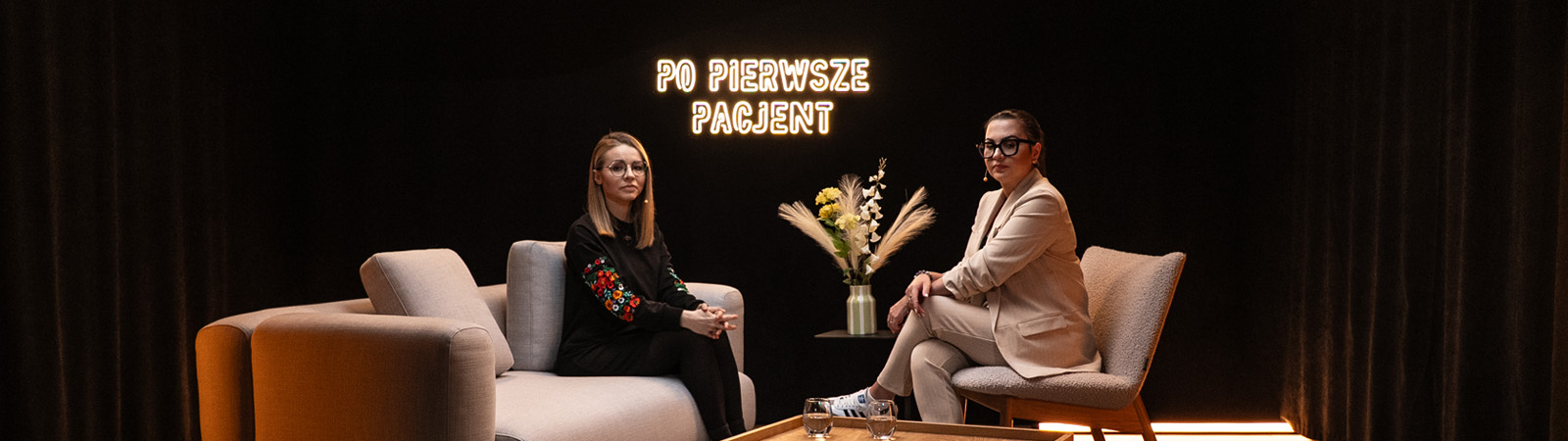
Hi. Monika Rachtan, I would like to welcome you very warmly to the next episode of the programme "Patient First". The climate that surrounds us affects our lives, but it also affects the lives of our children. I will be talking to my guest Kamila Kadzidłowska today about what we can improve and how to do it. A very warm welcome to you.
Kamila Kadzidłowska
Warm welcome.
Monika Rachtan
Kamila, you represent Parents for Climate. What pisses you off is that as a parent you also have to act socially so that your child, or maybe not even your child, because here it's probably no longer a chance, but that your grandchildren can live in an environment that doesn't harm them.
Kamila Kadzidłowska
Annoying is an understatement. It's really frustrating when you realise, when bringing children into the world and starting a family, that suddenly something like clean air, or healthy food, or a safe environment in general is a total luxury. That we seem to live in a part of the world where it seems like that should be the standard, but in fact when we start to look at it, when we start to investigate, to find out, for example, what the health problems of our children are, when we start to look at air quality issues, for example, when our children get sick and we find out that they get sick when it's smog season or when we find out that with such and such a diet there is no chance that a child can be healthy. And again we ask ourselves: but how is this possible? After all, these products are available in the shops. Suddenly, there is frustration and annoyance at the fact that we elect politicians for a reason. After all, there are public officials who should be keeping an eye on certain elementary issues. Of course, we wouldn't want to do that as parents. We have a job, we have a lot of other things to do, but very often we are faced with the choice to either just push these problems away, yes? To pretend they don't exist.
Monika Rachtan
And I think most do, don't they? Because if we were to worry all the time about the fact that our child goes to school and there's unhealthy food in the school shops, even though we've been promised we'd do something about it, that the lunch our child gets in the canteen isn't exactly healthy. Well, and now as a mum I have a choice: I can either prepare the boxes myself, educate my child, explain that crisps from the shop are not the best choice, or from the shop that is 200 metres from the school and that you bring your lunch to school because the one that is available at school is not healthy. But you know, it's another full-time job, because coming back from work at 6pm, picking up the kids from after-school activities you still have to stand up and get everything ready for tomorrow. And when is it time for yourself, and when is it time to relax? After all, everyone says we should also take care of our mental health, because sick parents are sick children.
Kamila Kadzidłowska
You've said so many important things in this speech that I don't even know where to start. Yes, of course. Our wellbeing as parents is insanely important in what kind of environment our kids mature in, our kids grow up in. But you started with your child going to school. Unfortunately, most kids, maybe not the majority, but especially in cities, rural-urban communities, they don't even walk on their own feet to school, they're also driven by their parents, which is already like a signal that this child is going to have a problem with overweight and obesity, with lack of exercise. This is very often the result. What is it because of? The fact that schools are constructed and designed in such a way that, in principle, it is impossible for children to walk to and from school safely, without being surrounded by exhaust fumes. That is, for them to have that basic dose of outdoor exercise. So unfortunately we are facing this problem, we don't even realise it.
Monika Rachtan
Do you think parents drive their children to school because they have this pollution problem? That this child just can't get to school safely because there is no pavement? Just is it also a question of a bit of convenience for the parents? Because, you know, I used to live in a housing estate where there were a lot of families with school-age children and there was one street where it was the street leading to the school and there was a perpetual traffic jam in the morning and I wondered about that. It wasn't some sort of busy road, so let's just say that this air pollution was certainly there, because it's everywhere already, but I think you could easily walk to this school on the pavement. It wasn't located on the main street, and yet there was this traffic jam just of parents taking their children to school. And, most importantly of all, I lived very close to the school and the children from my neighbourhood, who had a de facto 10-minute walk to the school, were also driven by their parents.
Monika Rachtan
And I'm thinking now, as you're talking about how there are certain factors that nevertheless make parents not want to let their child walk to school to have that healthy walk. And on the other hand I'm thinking about this situation that I've seen and I rather associated it with a total lack of awareness and with convenience.
Kamila Kadzidłowska
Because yes, it is just such a vicious circle. And one of the basic such first steps to prevent this is to make parents aware and educate them. One of my sons is in a community school and the headmistress at the beginning communicated clearly to parents in the first class about the start of the school year. Dear parents, if you can, come by bus or come on foot. There was great surprise for the parents who sent their children to the community school. How come, why should I leave my car somewhere further away? The headmistress explained in one sentence: because cars emit exhaust fumes. For the most part, these exhaust fumes are absolutely toxic to children's development, especially cognitive function. Children surrounded by exhaust fumes will learn less well, will be more prone to infections. And so on and so forth. Not to mention that this generates serious problems in the long term in the future. And that was enough. One sentence from the director made some parents say: And all in all, logical. In fact, whenever I can, I will come by bus or maybe we will come by bike. Enough is enough. And now we have an example from another state school that another child of mine goes to. He was going basically, already now his son is in high school. And there, even though a community organisation did a report, a solid report by the European Clean Air Centre, showing how many cars pass underneath the school, especially in the morning and afternoon, it came out there with over 1,000 cars in what seemed like a small neighbourhood on a small estate. This report showed how air pollution is peaking just at this time and it was shown in black and white what impact this has on children's health. What's more, parents are seeing these infections, health problems in kids, plus it's also correlated with dangerous situations around the school. Very often we have big cars, children are not visible, so they get out of these cars, they run, accidents happen. And even though such a report has been produced, which shows that around a particular school as much as possible, traffic needs to be calmed down. Parents need to be educated to try to bring their children on foot. This car traffic will decrease and this will also be better for the health of the children. Nevertheless, this message did not get through because the management knew that a discount store would already be built around the school. It is well known that a discount store with a huge car park will not calm down traffic and will not reduce air pollution. And here the priority of investment and big money won out. As if these issues of children's safety and health totally turned out to be irrelevant. So again, in the case of one school, it turns out that one short message from the head office at the start of the school year is enough, but it is also possible through Librus, the electronic diary or another platform to remind parents once in a while that listen, you are doing this for the health of your children. Both in terms of lowering air pollution concentrations, but also in terms of simply providing exercise for children. If we move more, you won't have to go with your children after school to an after-school activity somewhere. It's your time too, so arguments like this really appeal to parents. It's just that there has to be someone who articulates this, and if the management or the local authorities simply don't do it because they don't see the problem, or it's the solutions that contradict the investments, well, unfortunately we parents also see in the adverts that it's so cool that we just go with this child always to school and we don't ask ourselves this question, what will this result in the future, yes? Also the lack of independence of the children. In Japan in general, after the authorities realised how great the digital addiction of children was and also this access to processed food, also the huge urbanisation, did their part. For the mental health crisis, but in general the diseases of civilisation in children. There, in general, the policy is such that school facilities are now structured in such a way that basically children have to get to and from them themselves. It's supposed to be green, it's supposed to be safe, because children also learn independence through this. Not to mention that they also cook in schools, yes? That is, if there is a lunch break, the children eat what they cook from local products during the break. And these are in general solutions that we can dream of, but we talk about them very often as parents for the climate.
Monika Rachtan
I think that here, of course, dreams, but more the introduction of real solutions, which can bring us closer to just such a situation, is extremely important. I have the impression that, in general, Polish schools educate children who are totally unprepared for life. Recently I was talking to a friend whose daughter is in high school and she tells me that she is very afraid that her daughter will go to her first job in a while, because she assumes that at university she will study and work and that she won't know how to navigate the workplace at all, because for her something like, let's say, she would be employed in a restaurant. Operating a cash register, operating a computer keyboard, which is surprising to me, because children already spend most of their time on their phones and do all their errands there, they already sit at the computer less and less. That operating a printer, changing the toner in the printer is something she finds impossible for a child to do at all. And I have this feeling that, on the one hand, a little bit, schools, by giving children so much theoretical learning material, are taking away what is really needed in adult life, because, of course, apart from having a huge, extensive knowledge that children can easily acquire in high school and university, children in primary school are ready to learn how to cook healthy soup. They are ready to learn how to fix a tyre on a bicycle. These are things that should be implemented during such practical subjects that give not only theoretical knowledge, but above all this practice that will allow that child not to die in life. And I'm sorry, but by driving children to school, by doing everything for them, by not allowing them to do difficult household chores like vacuuming the house or washing the windows. We're raising some crippled kids and these kids come out of our homes, they're 19-20 years old, they're confronted with the reality of dormitory, student accommodation, rented accommodation and they say God, I can't do anything. It's horrible.
Kamila Kadzidłowska
And it's also amazing that everything you've said is already researched, tested, and this can be part of public health prevention, understood just broadly also taking into account our mental health, yes? Depressive disorders, because if a teenager feels that he can't do anything without the help of a parent who has to drive, bring him everywhere, yes? He can't do anything by himself. Well that doesn't affect wellbeing positively either.
Monika Rachtan
But again, do you think it's a matter of parental convenience and the fact that they prefer to give these children everything on a platter, to have peace of mind, because they don't want to take the time to educate them, to support them in this education? Is it a question of lack of awareness?
Kamila Kadzidłowska
It seems to me that, as parents, we are over-educated by adverts where we see some of these cool pictures of happy families feeding their children processed food. I say processed, but in the ad it's super sweet. Or they're all happily hanging out at a fast food joint, or just driving in a car somewhere through a beautiful countryside. There are never any traffic jams there in the adverts. And we're kind of chasing to have that car, to shop at that discount store or that fast food place and feed our families with that, but our lives aren't going to look like the lives of the people in the adverts. But we, as this very generation of parents, don't really connect the dots too much between the fact that we've been fooled a little bit by what the so-called free market offers us, which is very tempting. And now, yes, all of this very broad public health prevention through schools is already being implemented in Scandinavian countries, where it has just been realised that in order to rectify some of the mistakes of such a rampant free-market economy, which does not think about the consequences of eating unhealthy food or not having enough time to bring up children to be independent, it is precisely through schools. This is called the Nordic Schools of Resilience concept. Such schools of resilience. These schools are designed to be a place where not only is a sound education given to children, but also just such basic skills: how to cook something, how to fix something, where food comes from, how to cope in life, how to get from point A to point B. Also, how to participate in public debate? These schools are also such centres. Rather, it's all about being centres of public deliberation, centres where different generations of young people, parents and seniors can meet. But, of course, all this must be wisely managed somewhere by the authorities, who see that this is, in fact, an element of preventive health care, not only for children, but for whole communities, for the whole of society.
Monika Rachtan
Kamila, do you think that interests often win out over the health of our children and the health of society as a whole, when we are talking about food, about advertising, about the commercialisation of certain events? Do you notice, as Parents for the Climate, that it is more about, let's say, money and business than health?
Kamila Kadzidłowska
This is our experience. Even if, in the public forum, we are talking about such an initiative to do a review of the laws in terms of such provisions that harm the health of children. Is it when it comes to food issues, the availability of processed food? Whether it is in the area of transport, or when it comes to adapting to climate change, but also any other legislation that we have in Polish law, it is, of course, met with approval in the public forum, but to move on this topic, it is not at all feasible, because in a moment there are some stakeholders who simply know, We live a little bit in blissful ignorance of the lawmaking process in Poland and in the European Union, unfortunately. Unfortunately, it is the case that even where there is a very good law and a very good concept or idea, it is very often watered down by lobbyists and businesses who, when they appear before Senate and Sejm committees, for example in Poland, very often argue that we should not tighten up air quality standards, for example, because society will suffer as a result.
Monika Rachtan
But in what way?
Kamila Kadzidłowska
So it is amazing that coal merchants are resisting the Ministry's proposal to introduce higher standards for fuel burnt in boilers, so that we can breathe less polluted air, because I am not talking about clean air, citing arguments to the effect that no, because an ordinary lady or gentleman will pay more for this coal. We have to sell the worst quality coal, because otherwise we will have to sell more expensive coal and the poorest will not be able to afford it. So it is absurd that if a genuine social side appears at such committee meetings, it is able to take the floor and say no, just a moment. You speak on behalf of an industry that trades in low-quality fuel, so say that it is your profits that you are worried about. On the other hand, you need the voice of a society that calculates external costs. Breathing polluted air is about 150 billion zloty a year. That is how much we pay, I also had a doctor's appointment today, still a pharmacy. Today, I managed to visit my son at a state clinic. On the other hand, I usually fail. Every single visit is 250, 280, 300 zloty plus medication. This month I have 4 such visits. I have three children. We are in the smog season. We live in a neighbourhood that doesn't care about air quality. And now how we talk to the authorities about it, as a civil society we try to meet the authorities. The authorities don't want to meet us from just such localities, where these issues are not taken seriously. But sometimes we turn up at meetings and ask questions in public, and the authorities just spread their arms and say there's nothing we can do, because an investor has already built an investment here that generates additional air pollution. Right now I'm thinking of transport. And we can't do anything about it. But where were you when you granted permission for such investments?
Monika Rachtan
Exactly, I think that's also a problem, because on the one hand you have, let's say a mayor, an alderman, a city president. And this is a person who is elected for a certain period of time. And it's very often the case that he gets elected, makes some decisions. These decisions have consequences, some investment is made, but de facto, when it is finished and problems start with it, for example, this gentleman is no longer president, mayor or town mayor. Another gentleman or lady comes along, gets a bit of this rotten egg to add to his or her list of problems and has to do something about it. And that's the answer - well, what can I do when it's already standing? But do you think there is a chance to somehow wake up the politicians? To show them that if we don't address the problem here and now, then unfortunately the consequences in 10-20 years will be very serious and practically unsolvable. Because we today already understand to some extent what you said about infections, for example. If a child lives in polluted air, breathes smog every day, then automatically his respiratory system is weakened. And we all say that the biggest killer in Poland at the moment is cigarettes, cardiovascular disease, obesity, but we don't think about the consequences of polluted air for our children in 10-20 years' time, because maybe the cause of cancer will no longer be cigarettes, but just polluted air. So politicians need to be woken up. Do you have any ideas on how to do this?
Kamila Kadzidłowska
We have an idea of how to do it. We are trying to do this and it is our impression that it only reaches those politicians who are perhaps not decision-makers. Yes, we would like to believe that it is because of this that so little action is being taken in this direction or that, in our opinion, this action is really too slow. We have on the agenda the implementation of the Air Quality Directive into Polish law, and we would like it to be implemented now, really quickly, because this directive would allow us to breathe cleaner air. But we are finding out that this is going to be really, really delayed for years and probably delayed even more. Our children are probably not going to breathe that clean air.
Monika Rachtan
What is the argument of these politicians? Well, because you ask the question, you have a directive, certain measures are to be put in place and why is it not being done here and now, it's just being put in a drawer, When it's not a problem that can lie around, that's not topical, that's not important. What are they telling you?
Kamila Kadzidłowska
The politicisation of the subject, the politicisation of the subject, climate. Because those policies that affect our health, that are fundamental to our health, are within the competence of the climate and environment ministry. And that is ok. But it is very wrong that the Ministry of Health does not see these topics at all, that the Ministry of Health, as I will quote Professor Zielonka here, is more of a Ministry of Disease in the Polish system, and as long as the Ministry of Health does not extend special patronage to these very topics: a healthy environment, we will only be treating disease. We will only pay for medicines that make us feel better for a while. But we won't be healthy, our children won't be healthy and we, as seniors, will already be paying the even greater consequences of this, given the demographic factors. So it's this short-sightedness and this siloed approach to the problem. So the Ministry of Climate and Environment is trying to implement itself. Now it's going to try to come up with a plan to transpose this directive, and we as a social side, as Parents for the Climate ask all the time: where is the Ministry of Health in this process, because as long as it's going to be issues of some kind of climate, which may still seem abstract to some people, or some kind of environment, which is introduced more to environmentalists and to people who care about nature and will be treated separately from our health. Well, for a long time to come, in my opinion, we will simply be condemned to just treating these diseases. And what we need to tell ourselves straight is that there is no chance of us living a healthy life without access to clean air, healthy food and a healthy lifestyle.
Monika Rachtan
That is how little you would have to do in terms of prevention, in terms of changing your lifestyle, to be much healthier. We are very often told that when someone has high blood pressure or diabetes, they need to change their lifestyle. But, in fact, we should have the conditions to live a healthy life right from birth. Because if we have a child who is used to processed food from the very beginning. It is difficult for the parents to source healthy food, then how can we expect that at the age of 40 or 50 this person will suddenly wake up? All those bad things that have already happened in his body will somehow leave him and he will suddenly be a healthy person. This is unrealistic and impossible to do. But still coming back to the Ministry of Health, do you feel that the Ministry of Health is such a bit of an unwanted boy in the pack of colleagues? Because on the one hand we have the Ministry of Education, which, well, could also cooperate a little bit more with the Ministry of Health, we have the Ministry of Climate, which, well, also here our issues are very connected. We have the Ministry of Agriculture, which de facto also has a huge impact on our health, and this Ministry of Health nobody asks, it's better that they don't come and say anything, because they will still say that we are doing something unhealthy.
Kamila Kadzidłowska
Yes? What is more, I also have the impression, looking at the way the Ministry of Health functions and making various formal enquiries, that there are simply not enough staff there to deal with these matters in a human way. This is an appeal to the Prime Minister to consider the fact that in order to implement sensible public health prevention, which is on the agenda of the Polish Presidency, we need a solid department in the Ministry of Health, which will see these issues through, because there is no way we can take care of the mental health of young people and the whole prevention of civilisation-related diseases, which in fact result, once again, from the poor quality of the environment and food. Without cooperation with the Ministry of Health, all of this becomes a mess. There is also the problem of health and climate disinformation. And this disinformation has the same sources; it is fascinating, as we have been observing this phenomenon for years, that both the issues related to... I am not only talking about disinformation concerning vaccines, but about our health in general, about how important clean air is for us to function healthily, or healthy food, depreciating the planetary diet, which is good for the environment, because crops and so on. Cultures don't put as much of a strain on the environment as these standard, mass farms and good for our health. Huge money goes into this, into this misinformation. And now, because it's not in the competence of the Ministry of Health, it's treated all the time as some kind of climate policy that's being imposed on us by this evil Union and we don't need it at all. It really is no coincidence that these issues, these issues of health and climate disinformation, come to us from the same sources, because in general the weakening of the European Union and what we are seeing in Poland, the weakening of us, the huge polarisation that is taking place in Polish society around these issues, is also a huge threat to our security. I am speaking in such high-flown terms, referring to what is currently on the agenda in basically all ministries, including in the context of the presidency, that is, in general, our security as the European Union and as Poland.
Monika Rachtan
And do you think that this polarisation and misinformation is due to the fact that we are, however, uneducated, that those people who stand in opposition are people who, de facto, do not have the right knowledge to speak on a given topic at all, and they use what the Internet gives them, the information that some roll on TikTok or Instagram provides them with, and this is the authority for them. That's the basis for them to build an opinion on a subject.
Kamila Kadzidłowska
On the one hand, I would say it is more misinformation, i.e. not the intentional passing on of such false information, and disinformation itself, i.e. the intentional, deliberate passing on of false information to further social polarisation, to distance.
Monika Rachtan
Kamila, but that's not my point. My point is that as an internet user, because I believe you use Instagram and TikTok and that kind of social media, you browse around, you sit down, you scroll around in the evening, well you see, you see that this person is just talking crap and that this is a so-called internet troll who has been hired to create this kind of content. And I ask you: how do you do that, that you verify that? And why, for example, does the 50% society not verify this? Well, because, is there a lack of knowledge here, or is just giving something like telling someone that listen, you can't burn coal, it's really great and it doesn't harm anyone at all, is easier for that audience to accept and therefore they feed on that kind of information rather than the information that coal is a threat to our environment and to our health.
Kamila Kadzidłowska
You know, it's a powerful problem also related to information chaos, to information noise and to algorithms that see people susceptible to such information. They don't display to me. I sometimes, on purpose, go to the accounts of people who I know are celebrities spreading disinformation, but somehow their reels do not really display to me as often as they display to my relatives, who send me something so terrible once in a while. Alternatively, I tell them: yes, I know. This is this gentleman and that gentleman, the same information is or has been spread in such and such a context. Please, check, verify. So we also need to very much embrace, colloquially speaking, the big techs who have the tools to ensure that such misinformation is not spread, or that algorithms are not working against our public health. Because the fact that such content is being displayed is precisely to people, and still to people who are susceptible to passing it on. This is all researched, measured, deliberately calculated. This is what money is made on. Once again, the European Union has had a chance - and I hope it will not waste it - to put the brakes on Big Tech so that it can take better care of the tools that can sift out disinformation, especially in the area of health. Let us leave climate science for a moment. We know what this resulted in during pandemics. We also know what it results in, but yet we move on to climate disinformation in times of floods and disasters, for example. This is also extremely important. But unfortunately, this is the way social media is structured, that if there is no regulator here, that is, again if there is no law, then there is disinformation.
Monika Rachtan
It's just that it's a free-for-all and everyone throws in what they want and just...
Kamila Kadzidłowska
And now, of course, we are lacking that education, that sound climate education, media education. We can look here, for example, to Finland, which a decade ago created an excellent system, in fact, of such media education, but also one that is more life-like, and perhaps also because of its neighbour. But it's still in its infancy in our country. As Parents for the Climate, we see how much the Ministry of Education is trying to do in this direction, but we know that these topics are also very easily politicised. That is, again, as long as we are in an election cycle, in election campaigns, and we have been in it for two or three years now, it is just difficult to bring about any meaningful change. We are rooting hard for health education, but we are also appalled that with the doctor, with the Minister of Defence, this health education will not be compulsory in schools.
Monika Rachtan
It is appalling what the Deputy Prime Minister has done in terms of what he has said about health education. But at least the presidential candidate, Mr Rafal Trzaskowski has also said that he is in favour of us having a choice as parents and that we can decide whether our children will benefit from the subject of health education. I'm not going to comment on that, but Kamila, at the end tell me, what can we as parents, as parents who want to be aware, do to take care of our children's health while waiting patiently for state regulation? What are you paying attention to in your children's daily lives? What solutions are you investing in? What is a sticking point for you that allows you to breathe, to say: okay, I did everything I could?
Kamila Kadzidłowska
I remember such a conversation with Dr Maria Neira, she's a consultant to the World Health Organisation on air quality issues. And that's one phrase I always try to repeat somewhere, that if you don't know what's going on, remind yourself that what's good for nature is good for your family's health and de facto for your wallet. So I definitely try to implement solutions that I know are, like the planetary diet and good for nature and they are good for us and good for our health. As far as the movement issue is concerned, it's also a matter of choices, of course. I don't have to, really. Just because I have a car doesn't mean I have to drive it everywhere. I try to monitor the air quality, but first and foremost as parents, because we take these individual actions often. And then we reach a wall because we find that we have changed heating sources. We try to cycle and it's great because we get moving, but we're still breathing in fumes, we're breathing in smog, and the children at school don't have access to healthy food.
Kamila Kadzidłowska
So first and foremost it's up to us as parents to speak out about it. And not everyone wants to step out of their comfort zone and talk about it on social media, or go out on the street to join some sort of protest. I understand that. I also have a problem with it sometimes, but we really have the right and we should report it, problems like that, yes? That we see, for example, that our children at school don't have access to healthy food. To the authorities, to the relevant authorities in the municipality, because in fact even above the headmasters of the schools there is the head of the education department in our municipality and it is there that these daily decisions are made about what the infrastructure looks like in our surroundings, what the space looks like, whether we have access to green healthy spaces, because in general this should be our right, a constitutional right. To live healthy, to breathe clean air. But if we see that in the municipality the decisions of the authorities are going in such a direction that we are suffocating from smog and exhaust fumes, then we need to start communicating this, because let's be sure that there are investors in our municipalities who are talking to our authorities and these investors are not talking about what to do so that we can live in our settlements, in a healthier environment, they are talking about what to do so that it is easier to invest, yes? So that it's easier to make money by building more discount stores, completely ignoring those public health issues that are crucial to us or the environment. So we as parents need to give these signals to local authorities and we have access to them.
Monika Rachtan
Remember that you have a real impact on what the environment around you looks like. Your voice can also be heard. If you speak out about what you really want. Don't be afraid to do so. You are very welcome to do so. My guest today, but above all your guest, was Kamila Kadzidłowska. Thank you very much Kamila for our conversation.
Kamila Kadzidłowska
Thank you very much.
Monika Rachtan
This was the programme "First. Patient." My name is Monika Rachtan and I invite you to visit my social media.
Listen on your favourite app



Previous episodes
8 million smokers in Poland. Who will finally help us quit? Episode 109
A cigarette doesn't scream. It doesn't stagger like alcohol. It doesn't wreak havoc in sudden bursts of aggression. And yet - it is the one that quietly kills over 70,000 Poles a year. Nicotine, although legal and packaged in fashionable sachets or stylish e-cigarettes, is one of the most potent drugs known to science. And although we have known for decades how deadly it can be, Poland is still unable to combat it effectively.
Not all sex ends in orgasm - and very well. Episode 108
Did you know that thousands of women in Poland have no idea for years that... they are still virgins? And others give up sex not because they don't want to, but because every attempt ends in pain, anxiety, disappointment. In the latest episode of the podcast Po pierwsze Pacjent, Monika Rachtan talks to Professor Krzysztof Nowosielski - gynaecologist, sexologist and oncologist.
Urophysiotherapy, or how to regain a comfortable life after prostate removal. Episode 107
Can a procedure that saves lives also take away a sense of masculinity? In the latest episode of Patient First, Monika Rachtan talks to urophysiotherapist Kamila Grabek about complications after prostatectomy.
Polish Society for Holistic Medicine - a new direction in healthcare. Episode 106
What does it mean to treat a patient holistically - and is the health system in Poland ready for this?
Newsletter